Asenion is an AI governance platform with capabilities across the whole lifecycle of an AI system — from the policy that governs it before it is built, to the witnessed record, via Guardian, of what it actually did in production.
Organizations use Asenion to turn the rules that apply to their AI — regulations, standards, and their own policies — into something operational: structured controls, running assessments, tested models and agents, and tamper-evident records of what happened at runtime.
Most AI governance today lives in two places that never meet: documents that say what should happen, and systems where things actually happen. Asenion’s job is the thread between them — so that what your policy requires, what your team reviewed, what your tests showed, and what your AI did are one connected, verifiable record rather than four disconnected files.
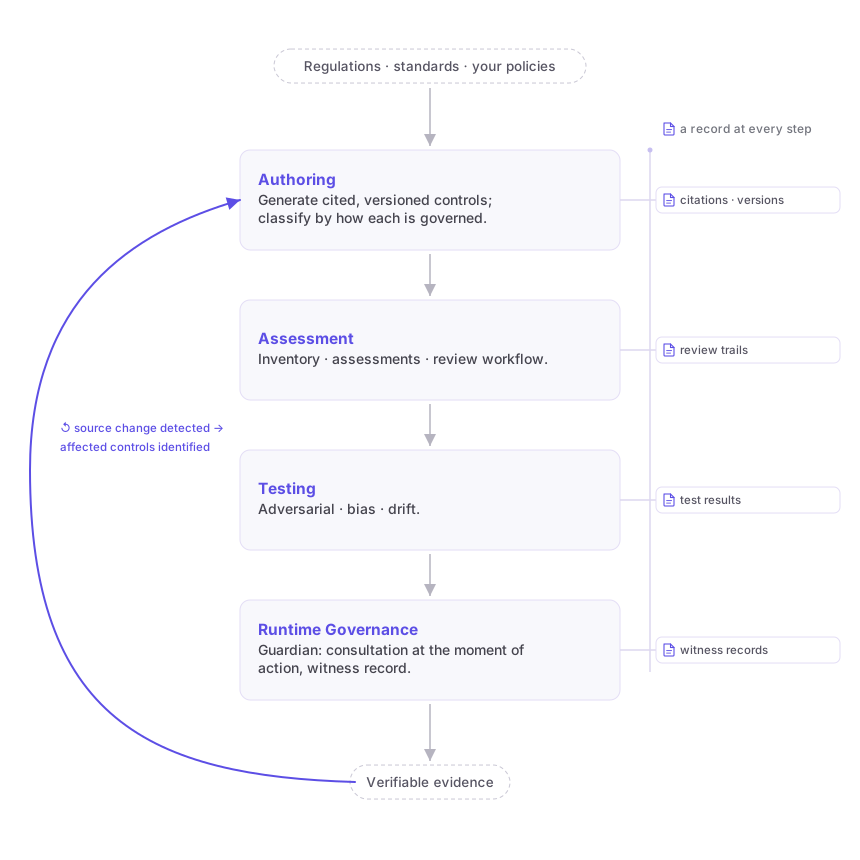
One platform, four capability areas
Authoring — from regulation to controls
Take a regulation or standard — the EU AI Act, ISO/IEC 42001, NIST AI RMF, NYC Local Law 144, among others — and generate structured controls from its actual text, with citations back to the clauses they implement. Controls are versioned, with tamper-evident history: you can always show which version of which source text a control came from, and what changed between versions. When a source regulation is updated, Asenion detects the change, diffs the text, and identifies which controls are affected — so re-authoring starts from the change, not from scratch, and your control library tracks the law rather than a snapshot of it.
Each control is classified by how it must be governed — as a documented obligation to assess, a measurable property to test, or a live condition an operating agent consults at the moment of action. One source text, routed to the three ways it will actually be governed. The next three capability areas are those three ways.
Assessment — the system of record
Register your AI in a hierarchical inventory — AI systems, models, agents, datasets, vendor components. Attach policies, assign owners, reviewers, and approvers, and run assessments against policy packs. Every item moves through a role-based review workflow with a full audit trail; lifecycle stages track each system from design through deployment. Reports draw from the same records your team works in, so reporting reflects the actual state of governance rather than a periodic reconstruction of it.
Testing — evidence before and beyond deployment
Evaluate the systems you govern: structured adversarial testing for LLMs and agentic systems, bias and fairness metrics across protected classes, and statistical drift detection for models in operation. Test results land in the same platform as the policies and assessments they answer to — evidence attaches to the system it belongs to, where reviewers and auditors can find it.
Runtime Governance — at the moment of action
Guardian is Asenion’s runtime governance layer. Your agents and applications consult it at the moment of a bounded action, and it surfaces the policies and guidance that apply. Every consultation produces a tamper-evident witness record: what was consulted, what guidance was returned, cryptographically chained so it can be verified afterward. Your integration decides how to act on the guidance — Guardian’s record proves what was surfaced, and when.
The record is the point
Most compliance evidence is attestation: someone signs a statement — “I attest that the control is operating” — and the statement is accepted on the signer’s authority. A witness record is a different kind of evidence. It is produced at the moment of action, not recalled afterward; it is chained so that tampering is evident; and it can be verified by someone who trusts no one involved. You don’t have to take anyone’s word for what your AI consulted or was told — you can check.
Everything in Asenion is built to that standard, at every stage: controls carry citations to source text and versioned history; assessments carry review trails; tests carry results tied to the systems they tested; runtime consultations carry witness records. When someone asks you to show your work — an auditor, a regulator, a customer’s security team — the record already exists, because it was made in the course of the work itself, not assembled for the occasion.
What Asenion is not
- It is not legal advice. Controls and guidance are generated from source texts and reviewed by your people; interpretation of the law belongs to your counsel.
- It does not replace human review — it structures it. Owners, reviewers, and approvers are people; the platform carries the workflow, the deadlines, and the trail.
- It is not an observability or monitoring tool. Guardian complements your monitoring stack; it sits at the decision point and produces governance evidence — it doesn’t watch metrics.
- Guardian does not block or approve actions on its own. It surfaces applicable guidance and witnesses what happened. Decisions — human or automated — belong to your integration. That is a design position, not a limitation: a governance layer you can trust is one that shows its work rather than one that silently acts.
Where to start
- Evaluating Asenion for your organization? Start with Trust & Security — deployment options, data handling, authentication, and architecture, written for a security or compliance reviewer.
- Building with Asenion? Start with the Quickstart — from zero to first value, self-serve.
- Looking for a term? The Glossary defines the platform’s vocabulary in one place.